 English
 Español
 عربى
عربى

Search by posts
Product category
Industry News
 By Admin
Ratchet Hook, Ratchet Lashing, Tow Straps and Steel Tow Rope: The Complete Buyer and User Guide
Which Tool Do You Actually Need?
If you are securing cargo on a flatbed, a Ratchet Lashing system with the correct Ratchet Hook is your best choice. If you are recovering or towing a vehicle, Tow Straps or a Steel Tow Rope are purpose-built for that job. These four products overlap in material and appearance but serve fundamentally different mechanical roles. Mixing them up can result in load shift, strap failure, or vehicle damage costing thousands of dollars and, in the worst cases, loss of life.
The single most important distinction is working load limit (WLL) versus breaking strength. Ratchet Lashing systems are rated by WLL, typically 500 kg to 5,000 kg per strap depending on webbing width. Tow Straps and Steel Tow Rope are rated by their minimum breaking strength (MBS), which is typically 3 to 4 times higher than the safe operating load. Understanding this difference before you buy or use any of these products eliminates the majority of real-world failures.
What Is a Ratchet Hook and How Does It Work
A Ratchet Hook is the end fitting attached to a ratchet tensioner or a tiedown strap. It is the component that physically grips a point on a trailer, flatbed, vehicle anchor rail, or cargo frame. The hook determines how force is transferred from the webbing into the anchor point, and a poorly chosen or worn hook is one of the most common causes of load release incidents.
Common Ratchet Hook Types
- J Hook: The most widely used shape. Slides over a D-ring, rail slot, or stake pocket. Works best when the anchor is a flat horizontal bar.
- Flat Hook: A wider, flatter version of the J Hook. Designed for stake pocket connections on flatbed trailers. Offers a larger contact surface and reduces point loading.
- Delta Ring Hook (D-Ring Hook): Terminates in a triangular ring that can rotate freely. Ideal for connecting to round or irregular anchor points without twisting the webbing.
- Snap Hook: Features a spring-loaded gate. Used in lighter-duty applications where speed of connection matters more than maximum load capacity.
- Wire Hook: A lightweight wire loop end. Used in smaller ratchet straps for motorcycles, ATVs, and light equipment.
Ratchet Hook Material and Coating Standards
The majority of commercial-grade Ratchet Hooks are forged from carbon steel or alloy steel and then either zinc-plated, powder-coated, or hot-dip galvanized. Zinc-plated hooks are suitable for indoor or sheltered transport but should be replaced after 18 to 24 months of regular outdoor use because zinc sacrificial coating degrades in UV light and road salt environments. Hot-dip galvanized hooks, with a coating thickness typically between 45 and 85 microns, outlast zinc plating by a factor of 3 to 5 in coastal or winter road conditions.
Stainless steel Ratchet Hooks, while more expensive, are increasingly used in marine cargo transport, food-grade logistics, and pharmaceutical distribution because they resist chloride-induced corrosion without any surface treatment maintenance.
How to Inspect a Ratchet Hook Before Each Use
- Check the hook throat for cracks, nicks, or visible deformation. Any crack is immediate grounds for disposal.
- Measure the hook opening. If the throat has widened more than 10% from the stamped dimension, discard the hook. A 25 mm throat that has opened to 27.5 mm or more is no longer rated.
- Verify the latch or safety catch operates freely. A stiff or missing latch means the hook can back out of its anchor under vibration.
- Check the swivel function if the hook is swivel-type. Grinding or binding in the swivel suggests internal corrosion.
- Look for wear marks on the bearing surface. Smooth, polished wear is normal. Sharp grooves or gouges indicate stress concentration points.
Ratchet Lashing: Construction, Ratings, and Correct Use
A Ratchet Lashing is a complete cargo securing assembly consisting of a polyester webbing strap, a ratchet tensioner mechanism, and two end fittings (most commonly Ratchet Hooks). The global standard governing Ratchet Lashing for road freight is EN 12195-2 in Europe and AS/NZS 4380 in Australia and New Zealand, while North American commercial carriers follow the FMCSA regulations in 49 CFR Part 393. Each standard specifies the minimum number of tiedowns, their placement, and the lashing capacity required per unit of cargo weight.
How the Ratchet Tensioner Mechanism Works
The ratchet tensioner is a pawl-and-ratchet assembly. When the handle is pumped, the axle winds the short end of the strap, progressively tightening the webbing over the cargo. The pawl prevents the axle from reversing under load. To release, a lever disengages the pawl, and the handle can be swung back to unwind. A correctly tensioned strap in a standard 35 mm wide ratchet lashing should produce a pretension force of approximately 300 to 500 daN (300 to 500 kilograms-force) when the handle is fully closed.
Working Load Limit by Strap Width
| Webbing Width | Standard WLL (daN) | Standard WLL (kg equiv.) | Typical Application |
|---|---|---|---|
| 25 mm | 250 | approx. 255 kg | Motorcycles, ATVs, light furniture |
| 35 mm | 500 | approx. 510 kg | Passenger cars, mid-size machinery |
| 50 mm | 2,000 | approx. 2,040 kg | Trucks, heavy equipment, steel coils |
| 75 mm | 5,000 | approx. 5,100 kg | Heavy industrial, excavators, generators |
How Many Ratchet Lashings Are Required by Law
Under FMCSA 49 CFR 393.106, the number of tiedowns depends on cargo weight and length. For cargo weighing 1,000 pounds (454 kg) or less, at least one tiedown is required. For cargo between 1,001 and 10,000 pounds (454 to 4,536 kg), a minimum of two tiedowns is required. For cargo longer than 10 feet, one additional tiedown is required for every additional 10 feet of cargo length beyond the initial 10 feet.
European regulations under EN 12195-1 use a friction-based lashing calculation. The minimum securing force required equals: cargo mass multiplied by 0.8g in the forward direction, 0.5g laterally, and 0.5g to the rear. On a 20,000 kg load at highway speed, forward securing force must exceed 156,960 Newtons (approximately 16,000 kgf) before the load is considered compliant.
Common Ratchet Lashing Mistakes That Cause Load Failure
- Running a strap over a sharp metal edge without an edge protector. A 2 mm radius steel corner can reduce polyester webbing breaking strength by up to 70%.
- Using straps with a lashing angle below 30 degrees to the horizontal. At 15 degrees, the effective vertical component of the strap tension drops to only 26% of the total strap load.
- Overtightening to the point of webbing bunching inside the ratchet axle. This creates uneven load across the webbing width and reduces actual breaking strength.
- Using a strap that has been chemically contaminated. Battery acid, hydraulic fluid, and bleach all degrade polyester webbing at a molecular level, often with no visible change to the strap appearance.
- Ignoring the strap label. Every compliant Ratchet Lashing must display a color-coded label with WLL, LC (lashing capacity), SHF (standard hand force), and STF (standard tension force). A missing or illegible label means the strap cannot be legally or safely used for commercial cargo.
Tow Straps: Types, Ratings, and the Science of Recovery
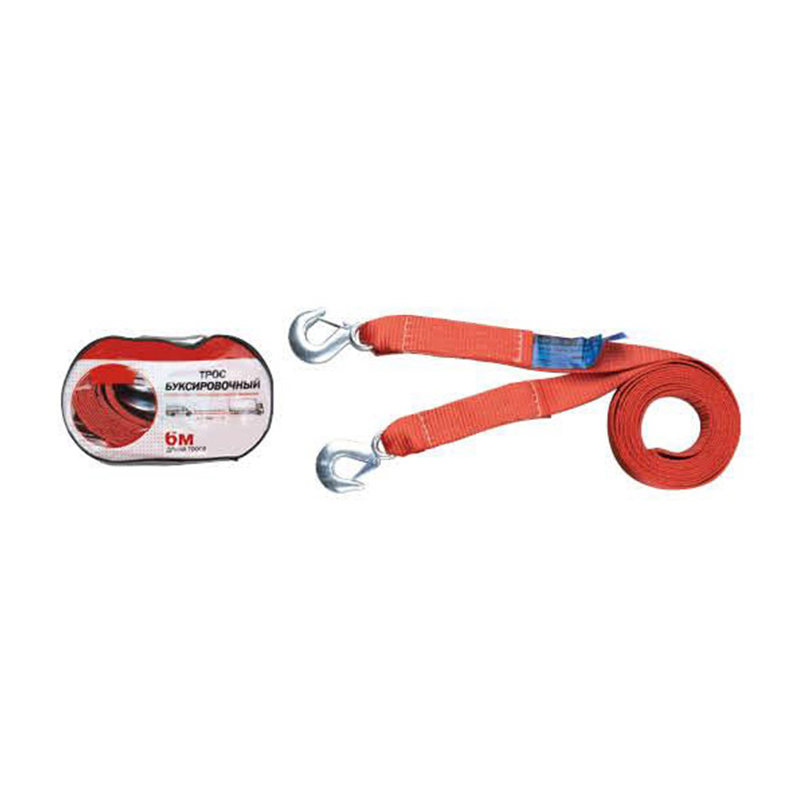
Tow Straps are flexible webbing or rope assemblies used to tow a disabled vehicle under power or to recover a stuck vehicle. Unlike Ratchet Lashing, Tow Straps are designed to handle dynamic, shock-load forces rather than static tension. This distinction is critical. A cargo strap used as a Tow Strap will almost certainly fail, potentially with lethal consequences.
Flat Tow Straps vs Kinetic Recovery Ropes
The two dominant categories are flat polyester tow straps and kinetic (elastic) recovery ropes made from nylon or double-braided nylon. They perform very differently:
- Flat Tow Straps: Made from polyester webbing. Very low stretch (under 3%). Designed for steady-state towing where the tow vehicle never applies a sudden jerk load. Available in loop or hook-end configurations. Common widths are 2 inch (50 mm), 3 inch (75 mm), and 4 inch (100 mm). Breaking strengths range from 8,000 lbs to 30,000 lbs depending on width and weave construction.
- Kinetic Recovery Ropes (KRR): Made from nylon with 20% to 30% elongation at rated load. Designed for vehicle recovery. When stretched, they store kinetic energy and release it in a controlled pulse that can extract a stuck vehicle weighing up to twice the recovery vehicle weight. A 7,500 kg-rated kinetic rope, for example, can successfully recover a bogged-down vehicle weighing up to 12,000 kg when used with correct technique.
Tow Strap Load Ratings Comparison
| Strap Type | Width or Diameter | Breaking Strength | Stretch at Rated Load | Best Use Case |
|---|---|---|---|---|
| Flat Polyester Tow Strap | 50 mm (2 in) | 15,000 lbs (6,800 kg) | Less than 3% | Roadside towing, light recovery |
| Flat Polyester Tow Strap | 100 mm (4 in) | 30,000 lbs (13,600 kg) | Less than 3% | Heavy truck towing |
| Kinetic Recovery Rope | 22 mm diameter | 15,000 kg | 20% to 30% | Off-road bogged recovery |
| Kinetic Recovery Rope | 28 mm diameter | 23,000 kg | 20% to 30% | Heavy 4WD and truck recovery |
How to Connect a Tow Strap Safely
- Always connect to manufacturer-designated tow points, typically stamped steel hooks welded to the frame or a rated tow ball. Never connect to a bumper, axle, or suspension component unless it is specifically rated for recovery loads.
- Use a rated shackle, not a hook, wherever the strap loops around an irregular anchor. A 4.75 ton (10,500 lb) screw-pin bow shackle is the minimum for most passenger car recovery.
- Lay a dampener (a recovery damper bag or heavy coat) across the strap midpoint. If the strap breaks under load, the dampener absorbs kinetic energy and prevents the strap ends from becoming projectiles. A snapped 20,000 lb Tow Strap carries enough energy to bend steel or penetrate a vehicle windshield.
- Ensure both vehicles are in a straight line before applying load. Lateral tow angles above 10 degrees dramatically increase the side load on tow points and shackles.
- Never exceed the rated working load. Tow Straps are not rated by WLL in the same way as cargo straps. They have a minimum breaking strength. The practical safe working load should be treated as no more than one third of the minimum breaking strength.
Tow Strap Degradation Factors
Polyester flat Tow Straps degrade primarily through UV exposure. A strap stored in direct sunlight for one full summer season can lose up to 40% of its tensile strength even with no physical use. Store all Tow Straps in a UV-opaque bag or enclosed storage box. Nylon kinetic recovery ropes are even more UV-sensitive; their elastic properties also degrade if they are stored fully stretched or in a tightly coiled position for extended periods.
Steel Tow Rope: Construction, Grades, and Correct Application
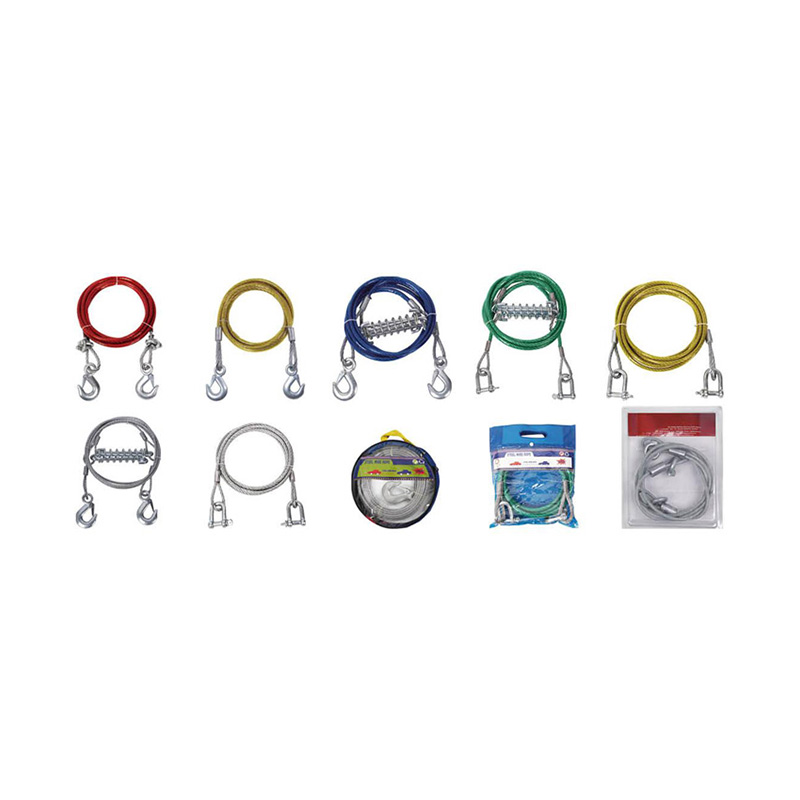
Steel Tow Rope (also called wire rope tow line or steel recovery cable) is constructed from multiple wire strands wound around a central core. Steel Tow Rope does not stretch under load, which makes it highly efficient for steady-state towing but dangerous for snatch recovery operations. The lack of elasticity means that all shock loads are transmitted instantaneously and in full to both vehicles and to the anchor points.
Steel Wire Rope Construction Designations
Wire ropes are described by the number of strands and the number of wires per strand. The most common constructions used in towing applications are:
- 6x19 (6 strands, 19 wires per strand): The standard construction for general-purpose towing. Good balance between flexibility and strength. Minimum breaking force (MBF) for a 10 mm diameter 6x19 rope in grade 1770 steel is approximately 59 kN (6,020 kg).
- 6x36 (6 strands, 36 wires per strand): More flexible than 6x19, better suited for applications where the rope must pass over small-diameter pulleys or sheaves. Used in crane and winch towing setups.
- 7x7 and 7x19 (aircraft cable): Very high strength per unit diameter. Common in motorcycle towing, ATV recovery, and as lashing for trailer gates. Not designed for heavy vehicle recovery without appropriate end terminations.
Steel Tow Rope Breaking Strength by Diameter and Grade
| Diameter (mm) | Construction | Steel Grade | MBF (kN) | MBF (kg approx.) |
|---|---|---|---|---|
| 8 mm | 6x19 | 1570 | 33.4 | approx. 3,400 kg |
| 10 mm | 6x19 | 1770 | 59.0 | approx. 6,020 kg |
| 12 mm | 6x19 | 1770 | 83.9 | approx. 8,560 kg |
| 16 mm | 6x36 | 1960 | 165.0 | approx. 16,830 kg |
| 20 mm | 6x36 | 1960 | 257.0 | approx. 26,200 kg |
End Terminations for Steel Tow Rope
The end termination is the weakest point of any Steel Tow Rope assembly. The three most common terminations used in towing are:
- Swaged (pressed) ferrule loop: A hydraulically pressed aluminium or steel ferrule crimped over the rope tail creates a fixed eye. Retains 90% to 95% of the rope MBF when correctly made. The most common factory-supplied termination.
- Wedge socket: The rope tail is threaded through a socket and a wedge is driven in to clamp it. Retains approximately 80% of MBF. Allows field installation without special tools. Used in heavy towing and construction crane setups.
- Bulldog grip (wire rope clip): U-bolts clamped over the rope tail that is folded back to form a loop. The rule of thumb is: never saddle a dead horse, meaning the U-bolt saddle must sit on the live (load-bearing) side, not the dead tail. Retains only 70% to 80% of MBF even when correctly installed with the right number of clips. The minimum number of clips for an 8 mm rope is 3; for a 16 mm rope it is 4.
When Not to Use Steel Tow Rope
Steel Tow Rope should never be used as a snatch recovery line. Its lack of elasticity means that if a tow vehicle accelerates hard and then hits the end of travel, the entire vehicle mass and rope mass decelerate in milliseconds. For a tow vehicle weighing 3,500 kg moving at just 10 km/h, the instantaneous shock load on a taut steel rope can exceed 50,000 kN depending on the deceleration duration. This is why vehicle recovery professionals universally prefer kinetic recovery ropes for stuck-vehicle extraction and reserve Steel Tow Rope for controlled, steady-state towing with a constant low speed.
Additionally, any kinked Steel Tow Rope must be retired immediately. A kink that has been loaded even once reduces the local strength of the rope by 50% or more and the kink can never be fully removed. A rope with a kink is a rope waiting to fail.
Side-by-Side Comparison: Ratchet Hook, Ratchet Lashing, Tow Straps, and Steel Tow Rope
The table below summarizes the practical differences between all four products across the most important decision-making criteria. Use this as a quick reference when selecting the right equipment for your task.
| Criterion | Ratchet Hook | Ratchet Lashing | Tow Straps | Steel Tow Rope |
|---|---|---|---|---|
| Primary function | Anchor connection point | Static cargo securing | Vehicle towing and recovery | Steady-state vehicle towing |
| Load type handled | Static tension | Static tension | Dynamic and shock loads | Steady tension only |
| Material | Forged steel or alloy steel | Polyester webbing | Polyester or nylon webbing | High-carbon steel wire |
| Elasticity | None | Less than 3% | 3% to 30% depending on type | Less than 1% |
| Governing standard | EN 12195-2, AS/NZS 4380 | EN 12195-2, FMCSA 393 | SAE J2056, AS 4438 | ISO 2408, ASME B30.26 |
| Failure risk if misused | Hook opens or fractures | Webbing tears, load shifts | Strap snaps, projectile risk | Wire whip, severe laceration |
| UV sensitivity | Low (steel) | Moderate (polyester) | High (nylon), moderate (polyester) | Very low (steel) |
Maintenance, Storage, and Service Life Guidelines
Extending the service life of all four products requires deliberate maintenance practices. Premature failure is almost always traceable to inadequate storage or ignored inspection, not to overloading during proper use.
Ratchet Hook and Ratchet Lashing Maintenance
- Clean the ratchet mechanism with a dry brush after every use in wet, muddy, or dusty environments. Do not use oil-based lubricants as they attract grit. Use a dry PTFE spray if lubrication is needed.
- Store straps loosely wound, not tightly coiled. Tight coiling accelerates creasing of the webbing core which weakens the fibers over time.
- Keep straps away from battery compartments, chemical storage areas, and exhaust pipes. Polyester webbing exposed to temperatures above 100 degrees Celsius begins to soften; above 180 degrees it melts.
- Replace any strap showing cuts, abrasion through to the core, heavy surface fuzzing, color fading of more than 50% of the strap length, or chemical staining. A faded strap is a strap that has suffered significant UV degradation.
- Formally inspect and record the condition of all Ratchet Lashing straps every 12 months for low-use applications and every 3 months for daily commercial use. EN 12195-2 requires straps to be removed from service if they cannot be positively identified as meeting their rated WLL.
Tow Strap Maintenance
- After any recovery use, check both ends of the strap for abrasion against rocks, roots, or metal edges. Recovery situations almost always expose the strap to abrasive ground contact.
- Dry nylon kinetic recovery ropes thoroughly before storage. Nylon absorbs up to 8% of its weight in moisture, and wet nylon loses approximately 15% of its tensile strength. Always dry a used kinetic rope before putting it back in its storage bag.
- Never use a Tow Strap that has been shock-loaded beyond its MBS. A strap that has been visibly stretched to its limit, even without visibly breaking, may have suffered internal fiber rupture and should be retired.
Steel Tow Rope Maintenance
- Lubricate Steel Tow Rope with a wire rope grease or penetrating oil every 3 months during active use. Dry wire corrodes from the inside out; internal corrosion is invisible until the rope fails.
- Check for broken wires. The retirement criterion under ISO 4309 for running ropes is 6 randomly distributed broken wires over a length of one rope diameter multiplied by 6, or 3 broken wires in one strand over the same length. For towing applications, any more than 2 visible broken wires per 30 cm should trigger immediate retirement.
- Never straighten a kink in a Steel Tow Rope and return it to service. A kink that has been loaded, even if it appears visually straightened, has permanent internal wire distortion.
- Inspect all end terminations after every heavy towing session. Check swaged ferrules for cracking or slippage marks. Check bulldog grips for loosening due to vibration.
Legal and Compliance Considerations for Commercial Use
Commercial operators using Ratchet Lashing and towing equipment face legal obligations that go beyond manufacturer recommendations. Non-compliance can result in fines, vehicle impoundment, and liability for cargo damage or road accidents.
Documentation Requirements for Ratchet Lashing
Under the European ADR (Agreement concerning the International Carriage of Dangerous Goods by Road) and under the UK Road Vehicles (Construction and Use) Regulations 1986, cargo must be secured by systems whose rated capacity can be verified. This means every Ratchet Lashing strap must have a legible, permanently attached label showing at minimum: LC (lashing capacity in daN), SHF in daN, STF in daN, and the manufacturer identification mark. A strap with a washed-out or missing label is not legally serviceable for commercial loads.
Towing Weight Limits and Licensing
In most jurisdictions, the towed vehicle weight versus the towing vehicle weight ratio is regulated. In the United States, federal law and most state laws require that a towed vehicle or trailer not exceed the gross vehicle weight rating (GVWR) of the towing vehicle, and most manufacturers specify a maximum tow rating that is typically 60% to 100% of the vehicle's curb weight for standard passenger vehicles. Using a Tow Strap or Steel Tow Rope to move a load beyond the towing vehicle's rated capacity is illegal and voids most vehicle warranties.
In the European Union, the EC Whole Vehicle Type Approval (WVTA) process means that each vehicle's approved towing capacity is listed in its Certificate of Conformity. Towing beyond this value renders the vehicle out of type approval and potentially uninsured in the event of an accident.
Occupational Safety Requirements
For workplaces in the United States, OSHA 1910.184 governs the use of slings (which includes web slings used in lifting and rigging contexts) and requires that all slings bear a permanent, legible identification mark and that workers be trained in their use and inspection. Employers are required to remove from service any sling that is cut, has broken wire strands, shows heat damage, or lacks identification marks. While OSHA 1910.184 specifically targets lifting applications, its inspection and marking standards are widely adopted as best practice for all cargo-securing and towing equipment in industrial settings.
Buying Guide: What to Look for and What to Avoid
The market for Ratchet Hook, Ratchet Lashing, Tow Straps, and Steel Tow Rope includes products spanning a 10:1 price ratio. The cheapest options are typically uncertified products with fictitious or unverifiable load ratings. Here is how to identify quality products and avoid dangerous counterfeits.
Certification Marks to Look for
- GS mark (Germany): Product tested by an independent certification body (e.g., TUV, DEKRA) against EN standards. One of the most rigorous third-party marks for mechanical hardware.
- CE marking: Self-declaration of conformity by the manufacturer to EU directives. Not independently tested but legally required for products sold within the EU. CE alone is a minimum standard, not a guarantee of quality.
- ASME B30 series compliance (North America): Rigging and lifting hardware that meets ASME B30.26 is tested by accredited laboratories. Look for the ASME mark on forged hooks and shackles.
- ISO 9001 manufacturing certification: Indicates the manufacturer has a documented and audited quality management system. Does not guarantee the product meets a specific load rating but indicates consistent manufacturing practices.
Red Flags When Buying
- Load ratings printed only on the packaging and not stamped, embossed, or labeled on the product itself. Ratings must be on the item.
- Webbing that feels unusually light or thin. A compliant 50 mm wide Ratchet Lashing strap at 2,000 daN WLL should weigh approximately 400 to 600 grams per 5-meter strap. Products significantly lighter than this are almost certainly underbuilt.
- Ratchet mechanisms with visible casting seams on load-bearing surfaces. Quality ratchets use forged or machined components. Die-cast zinc ratchets are not suitable for any load above 500 kg.
- Steel Tow Rope sold by the meter without any traceability to a standard. Reputable wire rope is always labeled with the manufacturer, construction designation (e.g., 6x19), steel grade (e.g., 1770), and nominal diameter. Generic unlabeled rope of unknown origin should never be used for towing.
- Tow Straps sold with hooks rather than loops at both ends for heavy recovery use. Hook-ended straps can become disconnected under the dynamic loads of vehicle recovery; loop ends connected through rated shackles are far safer.
Price vs Quality Reference Points
As of 2025 and into 2026, reasonable retail price ranges for quality, certified products in major markets are:
- 35 mm Ratchet Lashing strap (500 daN WLL, 5 m), pair: USD 18 to 45. Products below USD 15 for a pair of 35 mm straps are almost certainly uncertified.
- 50 mm Ratchet Lashing strap (2,000 daN WLL, 6 m), single: USD 35 to 80.
- Flat polyester Tow Strap (20,000 lb MBS, 20 ft/6 m): USD 25 to 60.
- Kinetic recovery rope (9,000 kg rated, 9 m, 22 mm): USD 90 to 180.
- Steel Tow Rope (10 mm, 6x19, 10 m, with swaged eyes): USD 30 to 70.
Practical Scenarios and the Right Choice for Each
Matching the right equipment to the right scenario is the practical goal of all the technical information above. The following scenarios cover the most common real-world situations.
Scenario 1: Securing a 2,400 kg Excavator Bucket on a Flatbed
Use four 50 mm Ratchet Lashing straps with flat hooks, each rated at 2,000 daN WLL. Position two straps in front of the bucket at a 45-degree angle to resist forward movement under braking. Position two straps rearward at 45 degrees. Use edge protectors anywhere the strap contacts the bucket's cutting edge. This configuration provides a total theoretical forward securing force of approximately 4 x 2,000 x sin(45) = 5,657 daN, well above the EN 12195-1 requirement of 0.8g x 2,400 = 18,835 N (1,921 kgf or 1,921 daN) for the forward direction.
Scenario 2: Towing a Broken-Down Passenger Car on a Paved Road
A 3 m flat polyester Tow Strap rated at 10,000 lb (4,536 kg) MBS is appropriate for a standard passenger car tow. Connect to the manufacturer-designated tow hook on both vehicles. Drive at no more than 15 km/h, keep tension on the strap at all times, and use clear hand signals between drivers. Never use a Steel Tow Rope for this scenario on public roads because there is no shock absorption if the tow car brakes suddenly.
Scenario 3: Off-Road Recovery of a Bogged SUV
This is the one scenario where a kinetic recovery rope is the only correct choice. Use a 7,500 kg-rated kinetic rope, 9 m long, with properly rated rated shackles (minimum 4.75 t bow shackles) at both ends. The recovery vehicle should weigh at least 80% of the stuck vehicle's weight, approach at a slow roll, and apply steady throttle rather than a sudden jerk. Place a dampener at the rope midpoint. Never use a Steel Tow Rope or a cargo Ratchet Lashing strap for this scenario.
Scenario 4: Securing Motorcycles or ATVs in an Enclosed Trailer
Use four 25 mm Ratchet Lashing straps (250 daN WLL) with wire hooks or soft loops around the handlebars and frame mounting points. Connect to the trailer's D-ring floor anchors. A typical motorcycle weighing 220 kg requires a minimum forward securing force of 0.8 x 220 x 9.81 = 1,726 N (176 daN), which is well within the capacity of two 250 daN straps used in combination. Do not overtighten, as excessive compression through the forks and suspension can cause front-end alignment damage.
Scenario 5: Connecting a Winch to a Stuck Vehicle via a Snatch Block
In a double-line winch pull using a snatch block, the Steel Tow Rope is loaded to approximately half the vehicle's extraction resistance but at twice the rope length. Use a 10 mm or 12 mm 6x19 steel rope with swaged loop ends and a rated snatch block with a minimum sheave diameter of 10 times the rope diameter (100 mm sheave for a 10 mm rope). A larger sheave diameter preserves more of the wire rope's rated MBF by reducing bending stress; a too-small sheave can reduce effective strength by up to 25%.
Frequently Asked Questions
1. Can I use a Ratchet Lashing strap as a Tow Strap in an emergency?
No. Ratchet Lashing straps are made from low-elongation polyester designed for static cargo holding. They have no capacity to absorb the dynamic shock loads generated during towing or vehicle recovery. Using a Ratchet Lashing strap as a Tow Strap risks sudden catastrophic failure, which can send strap hardware through vehicle glass at high velocity. In a genuine roadside emergency, drive slowly and use the strap to move the vehicle at absolute minimum speed with zero slack in the line, but replace with a proper Tow Strap as soon as possible.
2. What is the difference between WLL and MBS?
Working Load Limit (WLL) is the maximum load a piece of equipment is designed to bear in regular service. Minimum Breaking Strength (MBS) or Minimum Breaking Force (MBF) is the load at which the equipment is expected to fracture when tested. The ratio between MBS and WLL is called the safety factor. For Ratchet Lashing under EN 12195-2, the safety factor is 2:1. For lifting slings, it is typically 5:1 or 7:1. Never treat MBS as an operational load limit.
3. How do I know if my Ratchet Hook has been overloaded?
Visual signs of overloading include visible opening of the hook throat (compare the current opening to the stamped dimension), twist or lateral bend in the shank, cracking at the inside radius of the hook bend, and permanent deformation of the latch catch slot. Any of these signs means the hook must be removed from service immediately, even if the hook technically held the load.
4. How long do polyester Tow Straps last?
There is no fixed calendar life for Tow Straps, but most manufacturers recommend replacing straps used in regular commercial or recovery service every 3 to 5 years regardless of visual condition. For UV-exposed storage, the degradation clock starts the day the strap is first exposed to sunlight. A strap stored in a sunny truck bed year-round should be considered end-of-life within 2 years of purchase.
5. Can a Steel Tow Rope be repaired after it breaks?
No. A broken Steel Tow Rope cannot be reliably repaired to its original rated strength in the field. Splicing wire rope to restore it to MBF requires specialized tooling and is typically only performed in controlled industrial settings on specific rope constructions. Any field repair is a permanent load-bearing compromise. Retire and replace a broken rope.
6. What does the color coding on Ratchet Lashing labels mean?
Under EN 12195-2, the label color indicates the WLL of the strap assembly. The standard color designations are: beige or brown for 250 daN (25 mm strap), green for 500 daN (35 mm strap), yellow for 1,000 daN, grey for 2,000 daN (50 mm strap), red for 3,000 daN, and orange for 4,000 to 5,000 daN (75 mm strap). These colors apply to the strap label, not to the webbing color itself, which can be any color the manufacturer chooses.
7. Is it safe to use a Steel Tow Rope with a ratchet tensioner?
No. Steel Tow Rope should never be used with a standard polyester-rated ratchet tensioner. The tensioner axle, pawl, and body are rated for polyester webbing loads and will not correctly grip or wind steel wire. More importantly, the lack of elasticity in the rope means that any pretension applied by a ratchet will be lost the first time the combination experiences any dynamic load change, and re-tensioning with a ratchet on a wire rope is operationally impractical and dangerous.
8. What is the minimum safe towing distance between vehicles when using a Tow Strap?
Most road authorities and vehicle recovery organizations recommend a tow strap length of at least 4 meters for passenger car towing at low speed. This gives the driver of the towed vehicle enough reaction distance to avoid running into the tow vehicle if it brakes. For towing at speeds above 30 km/h on open roads, a 6 to 8 meter strap length is considered minimum best practice. Rigid tow bars are required by law for towing at normal road speeds in many jurisdictions precisely because a strap provides no rigid separation guarantee.
9. Can I weld a Ratchet Hook back onto a strap assembly if it breaks off?
No. Welding a Ratchet Hook alters the metallurgical properties of the steel at the weld zone, reducing hardness and creating residual stress concentrations. Most cargo hooks are made from quenched and tempered steel; welding softens the heat-affected zone and the hook's rated capacity cannot be restored. A replacement hook assembly must be sourced and installed using the manufacturer's specified connection method, which is almost always a sewn webbing loop or a swaged fitting, not a welded joint.
10. How do I calculate how many Ratchet Lashing straps I need for my load?
The basic calculation under EN 12195-1 requires you to determine the maximum inertia forces acting on the cargo in the forward, rearward, and lateral directions. For a cargo mass of M kilograms: forward force = 0.8 x M x 9.81 N; lateral force = 0.5 x M x 9.81 N; rearward force = 0.5 x M x 9.81 N. Divide the forward force by the WLL of one strap (converted to Newtons, where 1 daN = 10 N) multiplied by the sine of the strap lashing angle to the horizontal. Round up to the nearest whole strap. Always add a minimum of one extra strap beyond the calculated minimum as a safety margin, and always use straps in pairs symmetrically placed to prevent lateral load shifting.
Recommended News
-
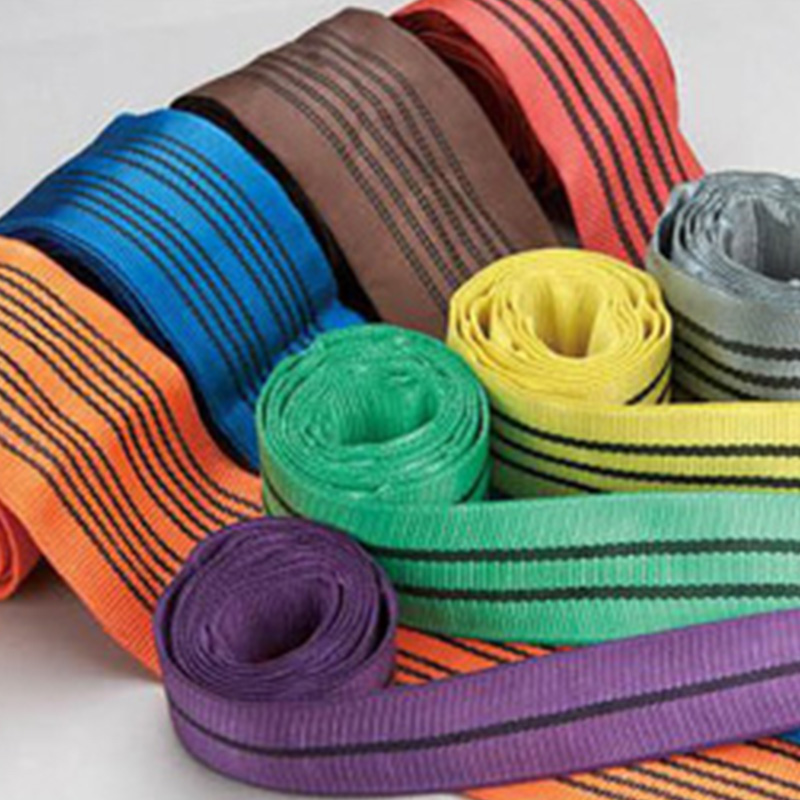
From structure to performance, a comprehensive explanation of high-strength polyester polyester round sling
-
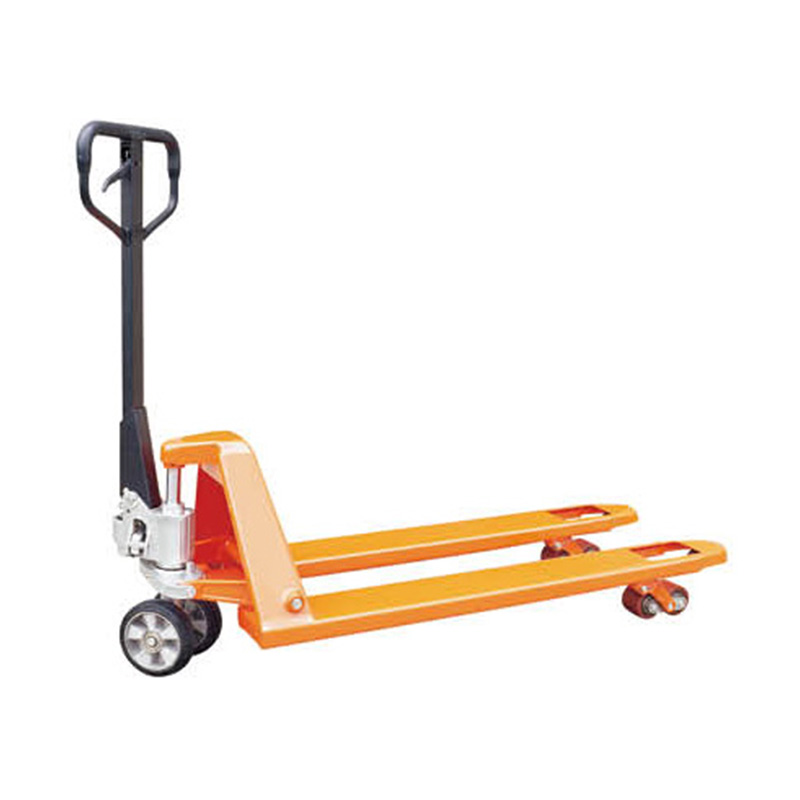
A comprehensive analysis of the functions, efficiency improvement, maintenance and troubleshooting of pallet trucks
-
How to make roadside assistance faster and more efficient with a tow belt?
-
What are the Key Techniques and Best Practices for Inspecting Steel Wire Ropes for Wear, Tear, and Potential Failures?
Copyright © NingBo Jiangdong Tianye Rigging Co,Ltd. Rights Reserved.
 Wholesale Webbing Hardware Manufacturers