 English
 Español
 عربى
عربى

Search by posts
Product category
Industry News
 By Admin
What is the best material for a tow rope?
Selecting the appropriate material for a vehicle tow rope is a critical operational decision across commercial transport, off-road recovery, industrial logistics, and agricultural equipment hauling. Moving a disabled, stuck, or heavy payload requires transmitting substantial tensile forces across a flexible linkage. Choosing an unsuitable material can lead to premature equipment breakage, ineffective recovery efforts, dynamic shock damage to vehicle chassis components, or severe safety hazards on the road and work site.
Determining the ideal material for a towing assembly depends on the specific physical demands of the recovery scenario. Static pulling along smooth highways demands structural rigidity and minimal stretch, whereas extracting a vehicle submerged in heavy mud requires dynamic kinetic elasticity to dissipate kinetic energy. Among the primary options available in modern transport engineering, the Steel tow Rope stands out as a foundational standard for high-tenacity, cut-resistant, and low-stretch static towing applications.
Understanding how different materials perform involves analyzing mechanical tensile strength, elastic elongation, abrasion resistance, environmental durability, and safety handling dynamics. By comparing steel wire rope, polyester web straps, kinetic nylon ropes, and ultra-high molecular weight polyethylene synthetic lines, equipment operators can select the precise material profile required for their specific transport and recovery tasks.
Evaluating Material Categories in Vehicle Towing Operations
The performance of any towing assembly is governed by the chemical and physical architecture of its underlying material. Towing ropes and straps are broadly categorized into metallic assemblies and synthetic polymer systems. Each material category possesses distinct mechanical behaviors when subjected to linear tension, bending stresses, and environmental exposure.
Evaluating tow line materials requires distinguishing between static towing and dynamic kinetic recovery. Static towing involves pulling a rolling vehicle at controlled speeds over paved or flat surfaces, where minimal line elongation is desired to maintain precise distance and steering control. Dynamic recovery involves extracting a mired vehicle from mud, sand, or deep snow using momentum, where elasticity is necessary to absorb sudden shock loads and prevent structural frame damage.
Metallurgical Foundations of Steel Tow Rope Systems
The classic Steel tow Rope is manufactured by cold-drawing high-carbon steel wire rods into thin, high-strength individual wires. These wires are helically twisted together around a central core to form multi-wire strands, which are then wound together to create a flexible, continuous wire rope structure.
Metallurgical processing endows high-carbon steel with exceptional ultimate tensile strength, high surface hardness, and minimal elastic elongation under heavy static loads. When tension is applied, a Steel tow Rope exhibits direct force transfer with negligible line stretch. This rigid structural response makes steel wire ropes highly effective for commercial recovery vehicles, flatbed winch lines, timber hauling, and industrial equipment transport where load stretch can result in un-controlled vehicle movement.
Synthetic Polymer Fibers in Vehicle Recovery
Synthetic towing lines utilize high-tenacity synthetic polymer yarns woven into flat webbing or braided into circular ropes. The primary polymers used in synthetic towing gear include polyester, polyamide, and ultra-high molecular weight polyethylene.
Polyester webbing is commonly used in flat tow straps due to its low elongation profile, high resistance to ultraviolet degradation, and stability in acidic environments. Polyamide, widely known as nylon, provides high elastic stretch, making it the primary material for kinetic energy recovery ropes. Ultra-high molecular weight polyethylene represents an advanced synthetic fiber that delivers tensile strength comparable to steel wire at a fraction of the physical weight, though it requires protective sheaths to prevent thermal friction melting and edge cuts.
Tensile Mechanics and Load Transfer Profiles
The mechanical behavior of a towing line under load determines how force transfers between the towing vehicle and the towed payload. Tension generates internal stress across the cross-sectional area of the line, causing a proportional physical lengthening known as strain.
Materials with high elastic moduli, such as steel wire and high-modulus synthetic fibers, stretch very little before reaching their working tension limit. This minimal stretch ensures immediate load movement, precise steering control, and predictable spacing during highway transport. Conversely, materials with low elastic moduli, such as multi-braided nylon, undergo significant elongation, storing kinetic strain energy that assists in snapping stuck vehicles out of heavy mud matrices while dampening dynamic peak forces.
Structural and Physical Analysis of Steel Tow Rope Assemblies
The structural construction of a Steel tow Rope enables it to perform reliable work under extreme mechanical demands that would sever or destroy standard synthetic materials. Understanding the physical layout of wire rope helps operators utilize its full mechanical potential while avoiding structural abuse.
A typical wire rope assembly consists of three basic components: the individual wires, the multi-wire strands, and the central supporting core. The arrangement of these elements dictates the flexibility, crush resistance, and fatigue life of the rope during heavy towing cycles.
Mechanical Construction of Multi-Strand Wire Rope
To create a Steel tow Rope, individual steel wires are wound into precise geometrical arrangements around a center wire to form a strand. Multiple strands are subsequently laid helically around a central core, which can consist of a synthetic fiber core or an independent wire rope core.
Fiber core designs utilize natural or synthetic fiber ropes inside the central axis, providing enhanced mechanical flexibility and internal oil storage for internal strand lubrication. Independent wire rope cores feature a smaller separate wire rope at the center, increasing total tensile strength and providing higher resistance to drum crushing when the rope is spooled under heavy tension on commercial recovery winches. The multi-strand arrangement allows individual wires to slide slightly past one another as the rope bends around winch drums, sheaves, and tow hooks.
Abrasion Resistance and Edge Cut Protection
One of the most notable functional advantages of a Steel tow Rope is its physical surface hardness and immunity to mechanical cutting. Towing operations frequently force ropes into contact with sharp chassis frame edges, burred steel bumpers, jagged rocks, concrete curbs, and metal towing eyes.
Synthetic fiber straps and ropes are vulnerable to edge notch propagation; a small cut on the edge of a tensioned synthetic strap can rapidly split the entire width of the webbing, leading to catastrophic line failure. In contrast, the high-carbon steel wires of a Steel tow Rope resist shearing forces, abrasive scraping, and localized cutting. Even if individual outer wires suffer surface abrasion, the inner structural wires continue to hold the tensioned load securely, providing a substantial safety buffer during rugged field recoveries.
Weathering, Chemical Resistance, and Thermal Endurance
Industrial and highway towing environments expose equipment to aggressive chemical contaminants, extreme thermal variations, and severe weather conditions. Ropes are subjected to road salts, spilled automotive fluids, diesel fuel, hydraulic oil, direct sun exposure, and sub-zero winter temperatures.
A hot-dip galvanized or stainless Steel tow Rope exhibits exceptional environmental stability. The metallic zinc coating acts as a sacrificial barrier, protecting the internal steel structure from atmospheric oxidation and rust. Unlike synthetic polymers that can suffer photo-oxidative degradation from long-term solar ultraviolet radiation or chemical weakening from organic solvents, steel wire rope retains its full structural integrity across broad thermal ranges and severe chemical environments.
Comparative Analysis of Towing Rope Materials
Evaluating which material is best suited for a tow rope requires comparing metallic and synthetic choices across critical operational criteria. The comparative matrix below outlines how primary towing materials perform across mechanical, environmental, and physical handling traits.
|
Towing Material Category |
Primary Structural Composition |
Elongation Under Rated Tension |
Resistance to Edge Cutting and Friction |
Resistance to Solar UV and Chemicals |
Physical Weight to Capacity Ratio |
Primary Operational Alignment |
|---|---|---|---|---|---|---|
|
Steel Wire Rope |
Multi-strand high carbon steel wire |
Minimal, low static stretch profile |
Exceptional resistance to severe cutting and abrasion |
High resistance to UV light, oils, and fuels |
Higher linear weight per unit strength |
Static load towing, flatbed winching, commercial recovery |
|
Polyester Webbing Strap |
Woven high tenacity polyester yarn |
Low to moderate elastic elongation |
Moderate, vulnerable to sharp structural edges |
High UV stability, good chemical resistance |
Lightweight, flat profile for easy handling |
Flatbed vehicle tie-down, highway static towing |
|
Kinetic Nylon Rope |
Double braided polyamide yarn |
High elastic stretch profile |
Moderate, requires protective abrasion sleeves |
Moderate UV vulnerability, absorbs moisture |
Moderate weight, highly flexible loop structure |
Off-road kinetic recovery, deep mud snatch extraction |
|
UHMWPE Synthetic Line |
High modulus polyethylene fiber braid |
Minimal, low static stretch profile |
Low to moderate, sensitive to sharp corner cuts |
Excellent UV resistance, inert to water |
Extremely lightweight, floats on water surfaces |
Lightweight winch lines, high capacity static pulls |
Interpreting Structural Attributes Across Recovery Scenarios
As detailed in the comparative matrix, no single material excels in every conceivable towing situation; rather, material attributes align with specific operational tasks. The low elongation and structural durability of a Steel tow Rope make it a dependable choice for static pulling, commercial vehicle towing, and harsh industrial environments where contact with sharp metal edges is inevitable.
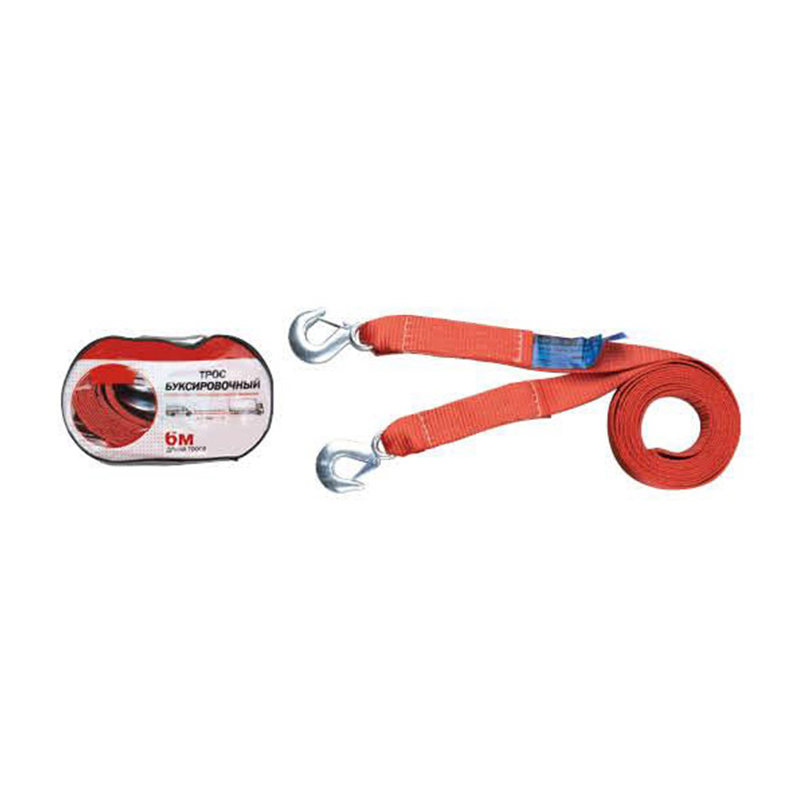
Polyester straps provide a balanced solution for standard light-duty highway towing where compact storage and soft vehicle contact are prioritized. Kinetic nylon ropes are specifically engineered for off-road extraction where dynamic dynamic vehicle momentum must be converted into smooth kinetic pulling force without shocking structural vehicle frames. Ultra-high molecular weight polyethylene offers high strength at low weight, though it requires careful management to prevent thermal friction damage and sharp corner shearing.
Balancing Static Load Pulling and Kinetic Energy Management
A fundamental rule in vehicle recovery is matching line elasticity to the recovery methodology. Attempting kinetic snatch recoveries with a rigid line like a Steel tow Rope can result in violent shock loading. Because steel wire rope does not stretch significantly to absorb dynamic kinetic peaks, the sudden impact energy generated by a moving tow vehicle is transferred directly into the tow hooks, frame rails, and mounting bolts, potentially tearing attachment points clear off the vehicle chassis.
Conversely, using a high-stretch kinetic nylon rope for flatbed winching or static highway towing creates un-controlled line recoil and spring-like vehicle surging, making precise vehicle positioning difficult and dangerous. Selecting the best material requires recognizing whether the task calls for rigid static force transmission, provided by steel wire rope, or elastic energy absorption, provided by kinetic polymer ropes.
Operational Safety Considerations and Hazard Mitigation
Vehicle towing and load extraction carry inherent physical risks due to the immense mechanical energy stored in tensioned lines. Safety management requires understanding how different materials store strain energy, how line failures occur, and how to protect operators and bystanders from kinetic hazards.
Implementing disciplined safety protocols, inspecting hardware regularly, and utilizing proper line dampening techniques drastically reduce workplace hazards during vehicle towing operations.
Managing Stored Strain Energy and Recoil Potential
When any towing line is tensioned, it stores potential mechanical energy proportional to its applied force and elastic stretch distance. If the line or an end attachment breaks under tension, this stored energy releases instantly, causing the broken line ends to whip back toward the anchor points at high velocities.
While a Steel tow Rope stores less elastic stretch energy than a nylon rope at equivalent tension, its higher mass density means that a severed steel cable carries massive momentum during recoil. To mitigate line whip hazards, operators must place heavy rubber line dampeners, winch blankets, or heavy sail bags over the center third of the tensioned steel line. In the event of line or hook failure, the dampener forces the recoiling cable down toward the ground, absorbing kinetic momentum and protecting personnel and vehicle windshields from high-velocity impacts.
End Fitting Integrity and Attachment Hardware Compatibility
A tow rope is only as reliable as its terminal attachment hardware. Connecting a high-capacity tow line to an undersized or improperly rated fitting creates a high-risk weak point in the recovery system.
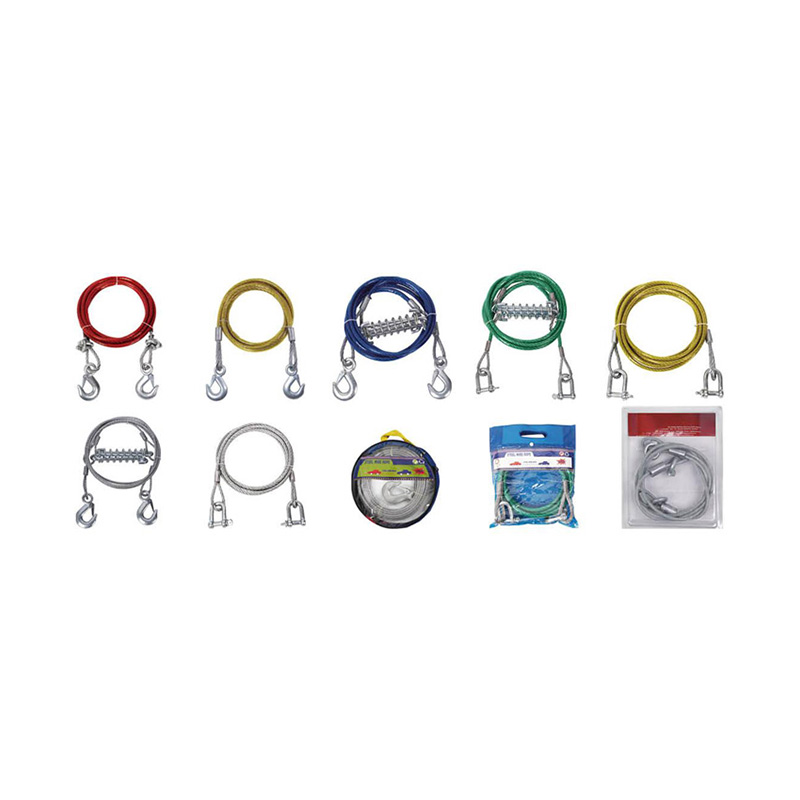
Steel tow ropes typically utilize mechanically swaged thimbling eyes, drop-forged steel hooks with spring safety latches, or heavy-duty alloy steel bow shackles. Operators must ensure that attachment hooks are secured directly to dedicated, factory-rated vehicle recovery points or structural frame cross-members rather than non-structural steering rods, sway bars, or decorative bumper guards. Utilizing alloy steel bow shackles with threaded screw pins provides a secure mechanical connection that prevents inadvertent hook disengagement during dynamic line slack cycles.
Visual Inspection Parameters and Mechanical Degradation Markers
Regular visual inspection of towing hardware is a mandatory safety requirement before and after every recovery operation. Continuous exposure to tensile stress, drum crushing, and physical ground contact induces physical wear over time.
Inspectors examining a Steel tow Rope must check the entire length of the cable for the following structural degradation markers:
-
Broken outer strands or individual wires protruding from the main rope body, commonly referred to as fish-hooks
-
Localized kinks, sharp bends, or permanent bird-caging where strands have opened up from localized severe twisting
-
Significant reduction in nominal cable diameter resulting from internal core failure or excessive inter-strand friction wear
-
Severe localized rust pitting or severe corrosion that compromises individual wire cross-sectional thickness
-
Crushed, flattened, or distorted sections caused by improper winch drum spooling under heavy load
-
Heat discoloration, electrical arc strikes, or weld spatter damage that alters metallurgical microstructures
Any steel wire rope exhibiting broken strand structures, severe kinking, or structural diameter reduction must be retired from service immediately to prevent unexpected line separation under load.
Field Applications Across Commercial and Recreational Transport
The physical capabilities of different tow rope materials dictate their selection across diverse global commercial sectors, recreational off-road hauling, and heavy industrial plant maintenance.
Commercial Flatbed Transport and Heavy Duty Towing
Commercial towing companies, vehicle recovery specialists, and flatbed equipment transporters rely heavily on Steel tow Rope assemblies for daily operations. Commercial winches mounted on rollback flatbed trucks operate under continuous static loads to pull disabled vehicles, damaged equipment, and heavy machinery onto loading beds.
The high surface hardness of steel cable withstands continuous scraping over steel deck rollers, aluminum loading ramps, and burred sub-frame rails without fraying or cutting. Furthermore, the low stretch characteristics of steel wire ensure that loaded vehicles remain firmly anchored during winching maneuvers, allowing tow truck operators to maintain precise control over load movement in busy traffic environments.
Off Road Vehicle Recovery and Kinetic Extraction
Recreational off-road enthusiasts, overland expedition teams, and search and rescue units frequently encounter vehicles stuck in soft sand, deep mud, marshland, or deep snowdrifts. In these low-traction terrain environments, static pulling is often ineffective because the towing vehicle cannot gain sufficient tire traction on the loose ground surface.
In off-road extraction, kinetic nylon ropes are widely favored over steel lines. The towing vehicle can take a controlled running start, using its momentum to stretch the kinetic nylon rope. The elasticity of the nylon absorbs the initial shock peak, protecting both chassis frames, and then smoothly contracts to pull the stuck vehicle out of the terrain matrix. Using a rigid Steel tow Rope for this type of momentum snatching is prohibited due to the extreme shock loads it would deliver to chassis mounting points.
Industrial Infrastructure and Agricultural Equipment Towing
Agricultural operations, forestry timber harvesting, and heavy civil construction sites involve moving massive equipment across unpaved, uneven, and harsh terrain. Heavy farm tractors, timber skidders, and tracked excavators require rugged towing gear capable of enduring continuous exposure to abrasive soil, mud, rocks, and high tensile loads.
In these heavy industrial sectors, large-diameter Steel tow Rope assemblies and heavy alloy chain bridles remain primary choices. Steel cables resist abrasive dragging through gravel, grit, and mud, while providing high ultimate tensile strength required to move heavy multi-ton industrial machinery. Their immunity to moisture rot, rodent damage, and chemical contamination ensures reliable service when left on equipment staging frames in outdoor work yards.
Maintenance, Storage, and Care Protocols for Long Service Life
Proper care, cleaning, and preventative maintenance directly impact the operational longevity, safety, and performance of tow rope hardware. Neglecting maintenance accelerates surface corrosion, internal friction wear, and fiber degradation, resulting in premature equipment failure.
Establishing disciplined maintenance routines preserves mechanical tolerances and ensures that towing gear remains ready for immediate deployment in emergency recovery situations.
Cleaning and Debris Management Across Metallic and Synthetic Lines
After completing towing or recovery operations in muddy, sandy, or salt-laden environments, towing lines must be thoroughly cleaned before storage. Entrained dirt and abrasive sand grains act as internal cutting agents, wearing down individual internal wires in steel ropes and severing synthetic yarns in polymer ropes during flexure.
To clean a Steel tow Rope, unspool the line completely and wash away mud and road grit using fresh water and a medium-bristled brush. Avoid using harsh chemical solvents or acidic degreasers that could strip factory lubricants or damage galvanized protective coatings. Allow the cable to dry thoroughly in a well-ventilated area to prevent surface moisture accumulation within the central core structure.
Lubrication and Surface Protection for Steel Tow Rope Hardware
Unlike synthetic straps that require dry storage, a Steel tow Rope requires periodic lubrication to preserve its internal structural health. As a wire rope flexes around drums and sheaves under tension, individual internal wires slide against one another. Without proper lubrication, dry metal-on-metal friction generates internal strand wear and accelerates corrosion inside the central core.
Apply a high-penetration wire rope lubricant specifically formulated to creep into the inner spaces between strands and the central core. These specialized lubricants displace residual moisture, coat internal wire surfaces with a protective anti-corrosion barrier, and reduce internal friction during flexure. Avoid applying thick, tacky automotive chassis grease to the outer surface of the rope, as heavy grease traps sand, grit, and dirt particles, creating an abrasive paste that wears down outer strand wires.
Rigging Technique Optimization and Angular Tension Reduction
Proper rigging mechanics preserve tow rope life and maximize directional pulling force. Applying sharp bending radii or steep towing angles severely degrades line breaking strength and induces localized structural distortion.
When connecting a Steel tow Rope to a vehicle, ensure that the cable passes over large-radius attachment fittings, smooth thimbles, or curved snatch block sheaves. Avoid wrapping a steel cable directly around sharp structural steel angles or narrow bumper brackets without edge protection, as sharp bends create permanent mechanical kinks and severely weaken individual strand wires. Furthermore, aim to keep the line of pull as straight as possible; pulling at sharp side angles increases line friction against winch drum flanges and reduces effective pulling capacity.
Storage Standards to Prevent Corrosion and Material Degradation
Proper storage environments safeguard towing hardware when it is not in active field service. Storing wet, dirty, or chemically contaminated ropes inside sealed, un-ventilated vehicle toolboxes promotes rapid degradation.
Clean, dried, and lubricated Steel tow Rope assemblies should be neatly coiled without tight twists or sharp bends and suspended on wide, rounded storage brackets in a dry, covered storage area. Keeping metallic and synthetic towing gear stored away from direct atmospheric weather, extreme heat sources, battery acids, and corrosive chemical fumes ensures that the equipment retains its engineered structural capacity, ready to perform safe, efficient vehicle recoveries whenever required.
Recommended News
-
From structure to performance, a comprehensive explanation of high-strength polyester polyester round sling
-
A comprehensive analysis of the functions, efficiency improvement, maintenance and troubleshooting of pallet trucks
-
How to make roadside assistance faster and more efficient with a tow belt?
-
What are the Key Techniques and Best Practices for Inspecting Steel Wire Ropes for Wear, Tear, and Potential Failures?
Copyright © NingBo Jiangdong Tianye Rigging Co,Ltd. Rights Reserved.
 Wholesale Webbing Hardware Manufacturers