 English
 Español
 عربى
عربى

Search by posts
Product category
Industry News
 By Admin
Three Types of Slings: Synthetic, Wire Rope, and Chain Slings Explained
A rigging supervisor in a steel fabrication plant walks into the tool bay and sees three slings hanging on the rack: a flat polyester webbing sling, a wire rope sling, and a grade 80 chain sling. The lift sheet calls for a 3.5-ton steel weldment with flame-cut edges. Which sling does he reach for? The answer is not a matter of preference. Each of the three types of slings behaves differently under the same load, and choosing the wrong one can damage the load, slow the job, or put people in danger. The three main sling families used in industrial lifting are synthetic slings, wire rope slings, and chain slings. The synthetic family includes flat webbing slings and round slings, both made from polyester or nylon yarns. Wire rope slings are built from steel wires stranded around a core, while chain slings are assembled from alloy steel chain, normally grade 80 or grade 100. Everything else, including weight, flexibility, heat tolerance, inspection frequency, and failure mode, follows from that material choice. This guide explains what each type is, how it is constructed, where it performs well, and where it should not be used. It also covers the practical selection factors that separate a safe lift from a dangerous one, so you can make a better decision the next time you buy or specify a sling. Industry standards such as ASME B30.9, EN 1492, and EN 818 classify slings by the material that carries the load. That material decides the sling's weight, its behavior around sharp edges, its reaction to heat and chemicals, and the type of damage an inspector needs to look for. Once you understand these differences, the rest of your rigging decisions become more predictable. The table below compares the three families at a practical level. It is a starting point for selection, not a substitute for the manufacturer's rating chart or a load test. The vertical load rating of any sling is determined by the weakest element in the assembly: the yarns in a synthetic sling, the wires and terminations in a wire rope sling, or the chain and hooks in a chain sling. Whatever family you choose, the rated working load limit printed on the label or tag is the reference you must respect. Never lift with a sling whose tag is missing, and never assume that a newer or thicker sling is automatically stronger. Flat webbing slings are made by weaving polyester or nylon filaments into a flat band. Polyester is the default material for lifting because it resists ultraviolet light better, stretches less under load, and tolerates most industrial chemicals better than nylon. Nylon is used when the application calls for higher elasticity and shock absorption, but nylon absorbs water and can lose roughly 10 to 15 percent of its strength when wet, so polyester is the safer general-purpose choice for most lifting work. Webbing slings are manufactured in single-ply and multi-ply versions. A single-ply sling is one woven layer. Multi-ply slings stack two, three, four, or more layers, with six, eight, and twelve layers common, to raise capacity without increasing width. The plies are sewn together with high-strength stitching, and the load-bearing eye at each end is formed by folding the webbing back and stitching it securely. The main configurations are eye-and-eye slings, which have a loop at each end for hooks or shackles; endless slings, which are continuous loops of webbing used in choker or basket hitches; and reversed-eye slings, which place two eyes at the same end to change the lifting angle. Some designs add triangle fittings or D-rings at the eyes to speed up connection, and others are supplied with protective sleeves that reduce wear at contact points. The first advantage is surface protection. Because a flat webbing sling spreads the load over a wide contact area, it does not mar, scratch, or dent painted, polished, or powder-coated surfaces. That makes it the first choice for moving machinery, prefabricated steel components, pallets, and fabricated cabinets where appearance matters. The second advantage is weight. A 3-ton polyester webbing sling can be carried with one hand, while a chain sling with the same capacity is heavy enough to create manual handling strain. This matters when riggers are connecting and disconnecting loads throughout a shift. The third advantage is flexibility. A webbing sling conforms to curved or irregular shapes and can be used in vertical, choker, or basket hitches. It has no metal parts to corrode or seize, so it stores compactly and introduces no spark risk in certain environments. When any of these conditions exists, switch to a wire rope or chain sling, or protect the synthetic sling with sleeves, corner protectors, and edge guards. The wrong choice here is one of the most common causes of sling failure in the field. From a purchasing perspective, examine the stitching pattern, the edge condition, and the tag. A well-made webbing sling has clean, uniform stitching at the eyes, no loose or broken fibers along the edges, and a permanently attached legible label that states the working load limit, the applicable standard such as EN 1492-1 or ASME B30.9, and the date of manufacture. Suppliers that cannot provide clear marking and traceability should be treated with caution. For many fabrication and warehousing tasks, a reusable polyester webbing sling with reinforced eyes offers the best balance of capacity, handling ease, and cost. Confirm the capacity tag against your heaviest lift and against the angle of your rigging before you order. A round sling is an endless loop made from a core of parallel, high-strength polyester yarns enclosed in a woven tubular cover. The cover does not carry the load; it holds the yarns together and protects them from wear. The inner yarns do the actual lifting work. Round slings combine exceptional softness with very high capacity. A round sling rated for several tons of load can weigh only a few kilograms, which is why construction and precast crews prefer them. The circular cross-section lets a round sling wrap tightly around pipe, beams, and irregular shapes, and the broad contact area spreads pressure over delicate surfaces. The cover is intentionally visible. When the inner yarns are damaged, the red or contrast-colored warning yarns woven into the core become visible on the surface. That is a clear signal to take the sling out of service, even if the cover itself looks intact. Like flat webbing slings, round slings are cut by sharp edges and weakened by heat and chemicals. Use edge protection wherever sharp contact is possible, and do not allow the load to land on the sling while it is being positioned. Round slings require inspection along the full circumference, because the cover can hide internal damage. Run your hand over the entire length, feel for lumps and flat spots, look for exposed warning yarns and chemical stains, and verify that the tag is present and legible. A well-made round sling will deliver years of service in normal construction use if it is stored dry, kept out of direct sun, and never pulled over sharp corners. Matching the color-coded capacity to the job follows the same rule as flat slings: trust the tag, not the color. Standards EN 1492-1 and EN 1492-2 use label colors to indicate capacity bands for synthetic slings. The table below lists typical color-to-capacity relationships used on webbing and round slings. In every case the sewn-in tag is authoritative; the color is a cross-check for quick identification on the job. In the United States, ASME B30.9 requires synthetic slings to be marked with the manufacturer, rated load, type, and length, but it does not prescribe a universal color code. Many US manufacturers follow a similar color convention, yet the only safe practice is to read the tag. If a tag is missing, faded, or covered so that the numbers cannot be read, the sling is unrated and must be removed from service. Tag loss alone is a valid reason to retire a synthetic sling. Wire rope slings are assemblies of steel wires laid helically into strands around a central core. The most common constructions are the 6x19 class and the 6x36 class, where the first number refers to the strand count and the second approximates the number of wires per strand. A 6x36 rope is more flexible than a 6x19 rope and is preferred when the sling must bend around smaller radii. A 7x19 rope is common for smaller-diameter flexible cable applications. The core may be fiber (FC) or an independent wire rope core (IWRC). IWRC construction supports higher loads, resists crushing, and provides better stability, which makes it the normal choice for load-bearing slings. Fiber-core rope is lighter and more flexible, but it should not be used where the rope may be squeezed, dragged, or run over by equipment. A standard wire rope sling consists of a length of rope with an eye formed at one or both ends. Common configurations include single-leg slings with two eyes, endless or grommet slings, and multi-leg bridles. Eyes are often fitted with steel thimbles to prevent crushing at the connection point, and hooks, shackles, or other hardware can be attached to complete the system. Termination efficiency matters when you calculate capacity. A hand-spliced eye retains roughly 80 to 90 percent of the rope's rated strength depending on the splice and the manufacturer, while factory swaged or compressed terminations typically retain a higher percentage. Always work from the working load limit printed on the manufacturer's tag, not from the rope's minimum breaking force. Wire rope slings offer the highest strength per diameter among the three families. They resist abrasion far better than synthetic webbing and tolerate higher service temperatures before derating becomes necessary. For outdoor rigging, demolition work, and long-span lifting, a wire rope sling is often the most practical choice. The trade-offs are stiffness, weight, and load protection. Wire rope will kink permanently if mishandled, and a kinked rope is a damaged rope. It can scratch or dent a load surface, it must be kept away from sharp bending points, and it provides no cushioning. Loads with sharp corners still require edge protection, because a corner can notch individual wires and start a fatigue crack. Corrosion is another concern, particularly in marine or humid environments. Galvanized or stainless wire ropes reduce some of that risk, but regular inspection is mandatory. A rope that looks dusty and dull on the outside may already have significant internal corrosion near the core. The rated WLL of a wire rope sling applies to a vertical lift. In a choker hitch, capacity drops to roughly 75 to 80 percent of the vertical rating. In a basket hitch with two legs parallel and vertical, the capacity is approximately double, but basket hitches with an angle between the legs reduce that multiplier. For a two-legged bridle, each leg carries more than half the load as the angle between the legs increases. At a 120-degree included angle, each leg carries 100 percent of the total load; at 150 degrees it carries nearly 200 percent. Industry practice discourages included angles beyond 90 degrees and never permits operation beyond 120 degrees unless the rigging has been engineered for it. Wire rope failures are normally visible before they become critical. Check for broken wires, corrosion pitting, bird-caging, core protrusion, kinks, heat discoloration, and damage to thimbles and hooks. Counting broken wires over one rope lay is the standard method: remove the sling when the number of broken wires reaches the limits set by ASME B30.9 or OSHA 1910.184. The practical inspection techniques and service-life indicators for steel wire ropes are covered in more detail in this guide to wire rope inspection. Fatigue from repeated bending around small radii is a leading cause of wire rope sling retirement. Keep records of every sling's service history so that a rope which has been heavily worked can be retired on a schedule rather than after a failure. Chain slings are assembled from alloy steel chain designed for lifting. The two grades that matter most in modern rigging are grade 80 and grade 100. Grade 80 has long been the industry standard for overhead lifting, while grade 100 provides roughly 25 percent higher working load limit for the same chain diameter, which reduces weight and improves handling on site. A chain sling is not just chain: it is a system that includes forged master links, connecting links, hooks, and often shortening clutches. The weakest component determines the assembly's rating, so hooks, links, and chain must all be matched and certified as a set. Mixing grades, brands, or even chain sizes within one assembly is a serious error. Chain is also highly predictable. Damage shows up as stretched links, bent hooks, and worn contact points, so an inspector can measure wear and elongation with a caliper rather than relying on feel. The first limitation is weight. A grade 80 chain sling for a 5-ton lift is heavy enough to create a manual handling risk, and the chain itself can damage a finished product if it is dropped on it. The second is conductivity. Chain is steel, so it conducts electricity. Never use chain slings near live conductors, on electrical work, or anywhere an accidental contact with a power line is possible. The third is notch sensitivity. Although chain resists cutting, a hammer blow, a gas torch cut, or a sharp gouge can create a notch that starts a crack under repeated loading. Inspect each link for nicks and deformation as well as for ordinary wear. Finally, chain costs more than synthetic slings on an initial basis. In heavy, abrasive, or hot service, the longer life usually justifies the price; in light and clean duty, a synthetic sling is the more economical choice. Chain slings should be cleaned and inspected periodically by a competent person. The key measurements are link pitch and cross-section. A chain is retired when the average cross-section at any load-bearing point has worn by roughly 10 percent, when a link has stretched about 5 percent beyond its original pitch, or when any hook shows visible twist, cracks, or a latch that no longer seats correctly. Individual links that are bent, twisted, or nicked can sometimes be replaced with matching-grade components, but replacement links must be the same grade as the rest of the chain. Never weld, heat, or hammer a chain link in the field as a repair. Assembled chain slings from a factory source come with matched components, clear ratings, and test documentation. For steel mills, forging shops, and sites with flame-cut edges, a grade 80 chain sling set is the dependable answer. Start with the conclusion: no sling family is universally better. The right type is the one that matches the load, the environment, and the way your crew works. Evaluate five factors in order: load weight, load geometry, temperature, environment, and handling. Sharp edges are the single most common reason synthetic slings fail. If the load has any flame-cut or burred edge, either select chain, or use an edge protector together with a synthetic sling. Do not assume that a thicker webbing sling is automatically safe against sharp edges; the capacity of the sling does not change its cut resistance. For loads with smooth surfaces that must stay scratch-free, a round sling or a wide webbing sling is the correct starting point. Wire rope and chain should be ruled out early in that decision. For sustained heat, such as moving parts fresh from a forge or a furnace, a chain sling with the correct derating is the only practical choice among the three. Wire rope can also handle elevated heat but begins to lose strength at lower temperatures than chain and is more easily damaged by direct contact with hot surfaces. Regardless of the sling family, the WLL is valid only for a vertical pull. As you open the angle between legs, each leg carries a larger share of the load. This is geometry, not a manufacturer's recommendation. The angle multiplier applies to every sling type, and it explains why experienced riggers keep the included angle below 90 degrees whenever possible. If you must work with a wider angle, reduce the load accordingly and verify that the sling assembly is still within rating. Here is a sequence that works for most routine lifts. First, identify the load weight and its center of gravity. Second, examine the load surface: anything sharp or abrasive points toward chain or protected synthetic. Third, check the environment: temperature, UV, chemicals, and moisture. Fourth, decide the hitch: the less convenient the hitch, the more flexible you want the sling to be. Finally, consider the crew: heavy chain slings slow down a job and raise strain-injury risk, while synthetic slings are easier to handle but demand greater care around edges. A balanced rigging inventory contains all three families. Buy the type that fits the most frequent job first, add the other types gradually, and standardize on one reputable supplier so that ratings, inspection procedures, and documentation stay consistent across your tool sets. Every sling has a service life, and the decision to retire it should be made on what you can see and measure. The starting point in ASME B30.9 is a pre-use inspection by the operator each day, and a periodic inspection by a designated competent person at least annually, or more frequently in severe service. The first step on any sling is the tag. If the tag is missing or unreadable, the sling has no rating and must be taken out of service immediately. There is no way to safely guess the capacity of an unmarked sling, and there is no excuse for lifting with one. Do not attempt to repair a damaged synthetic sling. Sewing a new eye or patching the body is not permitted under ASME B30.9; the sling must be replaced. Run a cloth or glove pad along the rope during routine inspection; a broken wire will often snag the fabric even when it is not yet obvious to the eye. Chain hooks must be checked specifically at the throat opening. If the throat has opened beyond the manufacturer's tolerance, the hook is permanently damaged. Some standards use templates; others use direct measurement. Follow the method in the manufacturer's manual and record the readings. Store all slings hanging on a clean rack, out of direct sunlight, and away from heat, sparks, and chemicals. Synthetic slings should be dry before storage. Wire rope slings should be coiled or hung to avoid kinks. Chain slings benefit from a light film of rust-preventive oil, but many rigging teams keep chains dry in clean environments; the important thing is to prevent corrosion without creating a contamination hazard for the next lift. Keeping a simple log for each sling, with date of purchase, inspection dates, and retirement notes, costs little and gives you the data to improve future buying decisions. It also shows auditors and safety inspectors that your program is disciplined rather than reactive. The three types of slings exist for good reasons. Synthetic webbing and round slings give you a light, flexible, load-friendly tool that is easy to handle and inexpensive to replace. Wire rope slings bring steel-grade strength, heat resistance, and abrasion resistance for demanding outdoor and heavy industrial work. Chain slings deliver the best cut resistance and adjustability for steel, foundry, and high-temperature environments. The essential rule is to match the sling to the task using weight, load geometry, temperature, environment, and angles, and to verify every sling before each lift. A correctly selected sling, used within its rating, is a reliable tool. A misapplied one is a hazard in plain sight. When buying, work with a manufacturer that produces slings in-house, documents ratings and certification, and understands international standards such as ASME B30.9, EN 1492, and EN 818. Buying from a factory-backed supplier helps you confirm consistent quality and traceability across all three sling families. Build your inventory to cover the range of work you actually do, keep every sling inspected and tagged, and train your riggers to treat capacity charts and angle factors as non-negotiable rules. That combination, the right type, the right rating, and the right care, is what keeps a lift safe and your operation running.The Three Main Types of Slings at a Glance
Sling Family
Typical Materials
Common Configurations
Typical WLL Range
Primary Strengths
Primary Limitations
Synthetic slings
Polyester or nylon webbing, polyester yarn core
Eye-and-eye, endless, single-ply or multi-ply, round endless loops
500 lb to 100,000+ lb
Light, flexible, protects the load surface, color-coded, easy to store
Easily cut by sharp edges, sensitive to heat and UV, may degrade in chemicals
Wire rope slings
Carbon steel wires around an FC or IWRC core
Single-part, endless grommet, multi-leg bridles with thimbles and hooks
1,000 lb to 100,000+ lb
High strength, heat resistance, abrasion resistance, predictable inspection
Stiff, can kink, corrosion risk, hard on load surfaces, heavy
Chain slings
Alloy steel chain, grade 80 or grade 100
Single-leg, 2-leg, 3-leg, 4-leg assemblies with master links and hooks
2,000 lb to 100,000+ lb
Very durable, cut-resistant, adjustable, suitable for high heat with derating
Heavy, relatively expensive, requires careful inspection, conductive
Synthetic Slings: Flat Webbing Slings
How Webbing Slings Are Built
Advantages of Webbing Slings
Limitations You Need to Respect
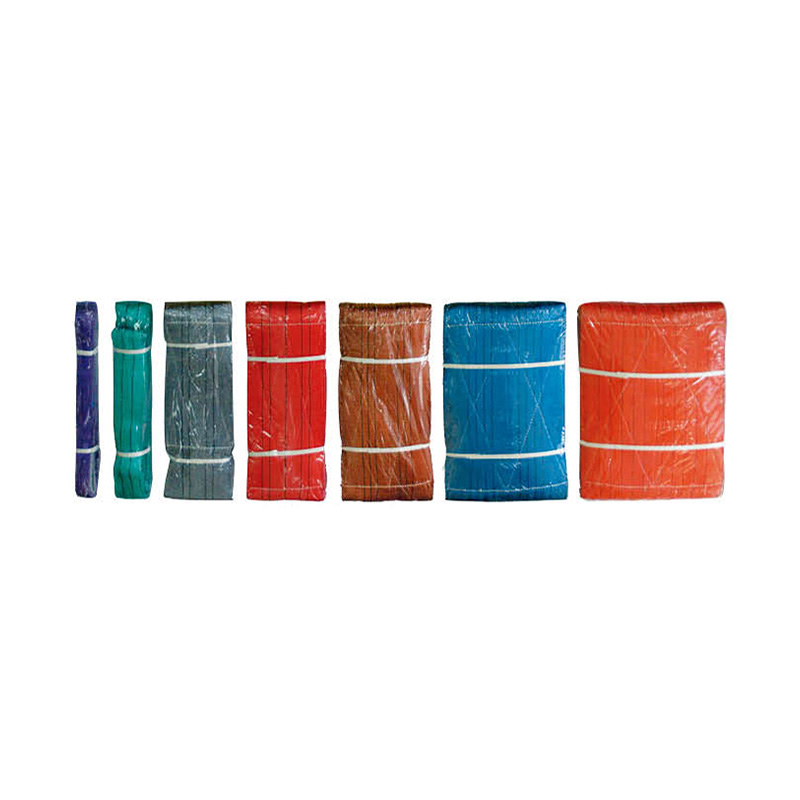 Reusable Polyester Webbing Sling with Reinforced EyesThis flat webbing sling is built from high-tenacity polyester with reinforced lifting eyes and is available in multiple ply options and lengths. It suits fabrication and warehousing lifts where balanced capacity and easy handling matter.View Product →
Round Slings
When Round Slings Make Sense
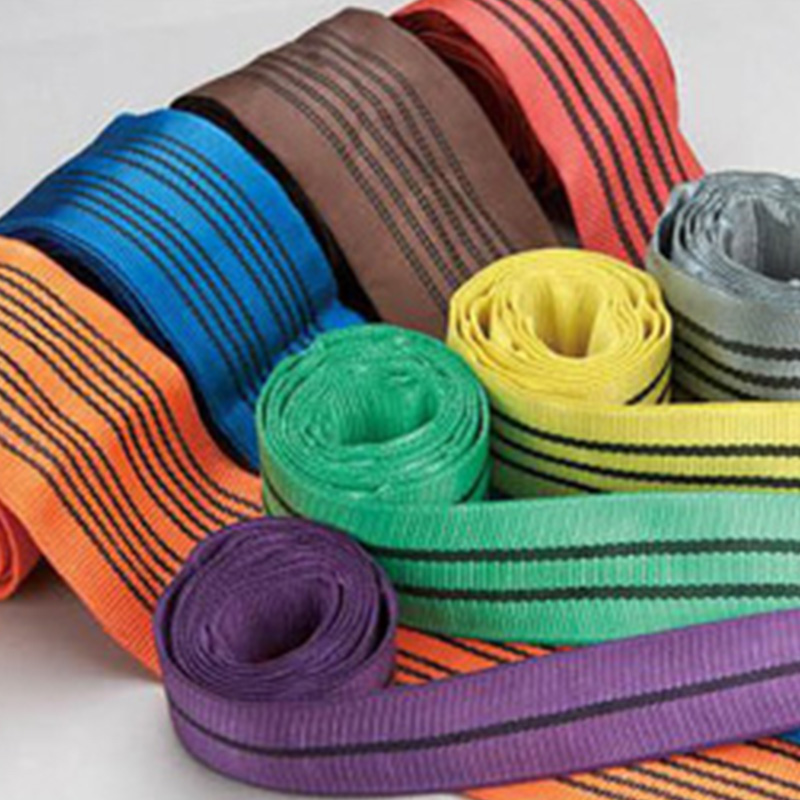
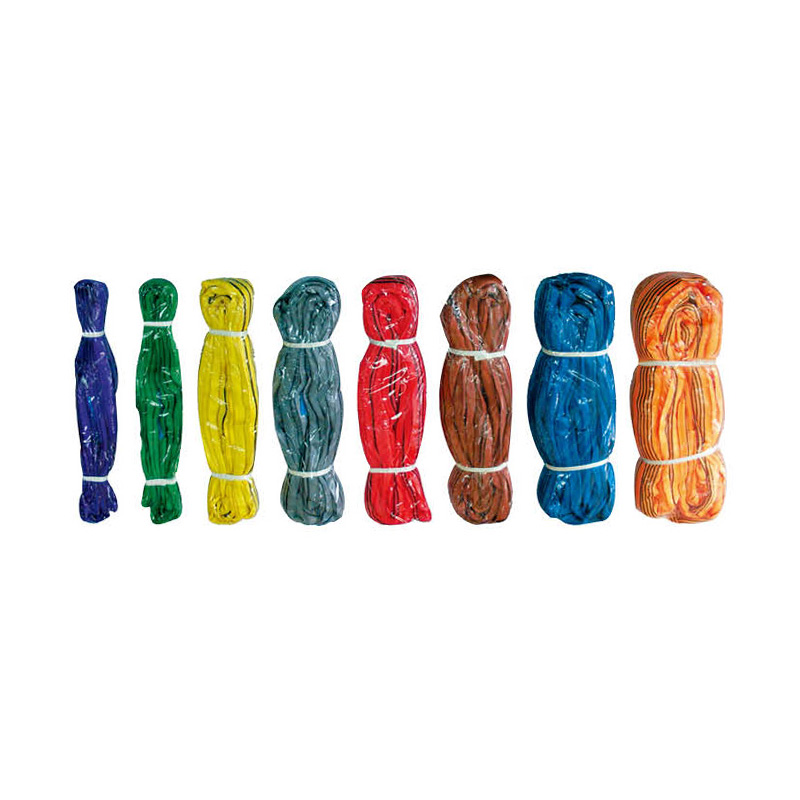 Color-Coded Round Sling with Protective Polyester CoverThis round sling features a high-tenacity polyester core protected by an abrasion-resistant tubular cover. It is color-coded for capacity and available up to 20 tonnes, making it suitable for construction lifts when inspected along the full circumference.View Product →
Color Coding and Capacity Marking
Label Color
Webbing Sling WLL (typical)
Round Sling WLL (typical)
Violet
1 t
1 t
Green
2 t
2 t
Yellow
3 t
3 t
Gray
4 t
4 t
Red
5 t
5 t
Brown
6 t
6 t
Blue
8 t
8 t
Orange
10 t
10 t
Wire Rope Slings
Configurations and Terminations
Strength, Heat, and Abrasion
Hitches and Angles
Inspection of Wire Rope Slings
Chain Slings
Why Choose a Chain Sling
Limitations to Keep in Mind
Chain Sling Inspection
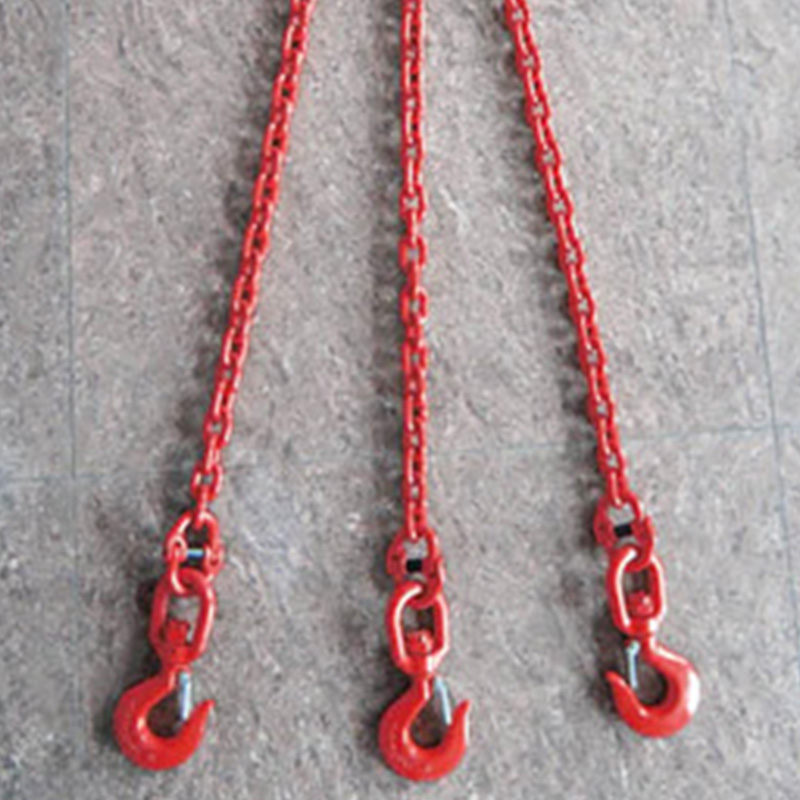 Grade 80 Alloy Steel Chain Sling SetThis chain sling is made from quenched and tempered super alloy steel, individually proof-tested, and available in single, multi-leg, and endless configurations. It provides dependable lifting for demanding steel mills and forging shops.View Product →
How to Choose the Right Sling Type
Decision Reference Table
Condition
Synthetic
Wire Rope
Chain
Sharp edges on the load
Needs protection or edge guards
Needs some protection
Best resistance
Sensitive or finished surfaces
Best protection
Poor
Avoid
High temperature above 100 °C
Avoid
Good with limits
Best with derating
Outdoor sun exposure
Polyester acceptable, nylon poor
Good
Good
Corrosive or marine environments
Check chemical compatibility
Use galvanized or stainless
Corrosion risk
Frequent flexing around small radii
Excellent
Poor due to fatigue
Good
Frequent length adjustment on site
Not adjustable
Not adjustable
Excellent
Cost per tonne of capacity
Lowest
Moderate
Highest
Manual handling weight
Lightest
Heavy
Heaviest
Angles Change Everything
Included Angle Between Legs
Load per Leg as % of Total Load
0° (legs parallel)
50%
60°
58%
90°
71%
120°
100%
150°
193%
Practical Selection Logic
Inspection, Maintenance, and Retirement
Synthetic Sling Removal Criteria
Wire Rope Sling Removal Criteria
Chain Sling Removal Criteria
Storage and Care
Final Recommendation
Recommended News
-
From structure to performance, a comprehensive explanation of high-strength polyester polyester round sling
-
A comprehensive analysis of the functions, efficiency improvement, maintenance and troubleshooting of pallet trucks
-
How to make roadside assistance faster and more efficient with a tow belt?
-
What are the Key Techniques and Best Practices for Inspecting Steel Wire Ropes for Wear, Tear, and Potential Failures?
Copyright © NingBo Jiangdong Tianye Rigging Co,Ltd. Rights Reserved.
 Wholesale Webbing Hardware Manufacturers